


Discover How Iron Catalyst Speeds Up Reactions Fast
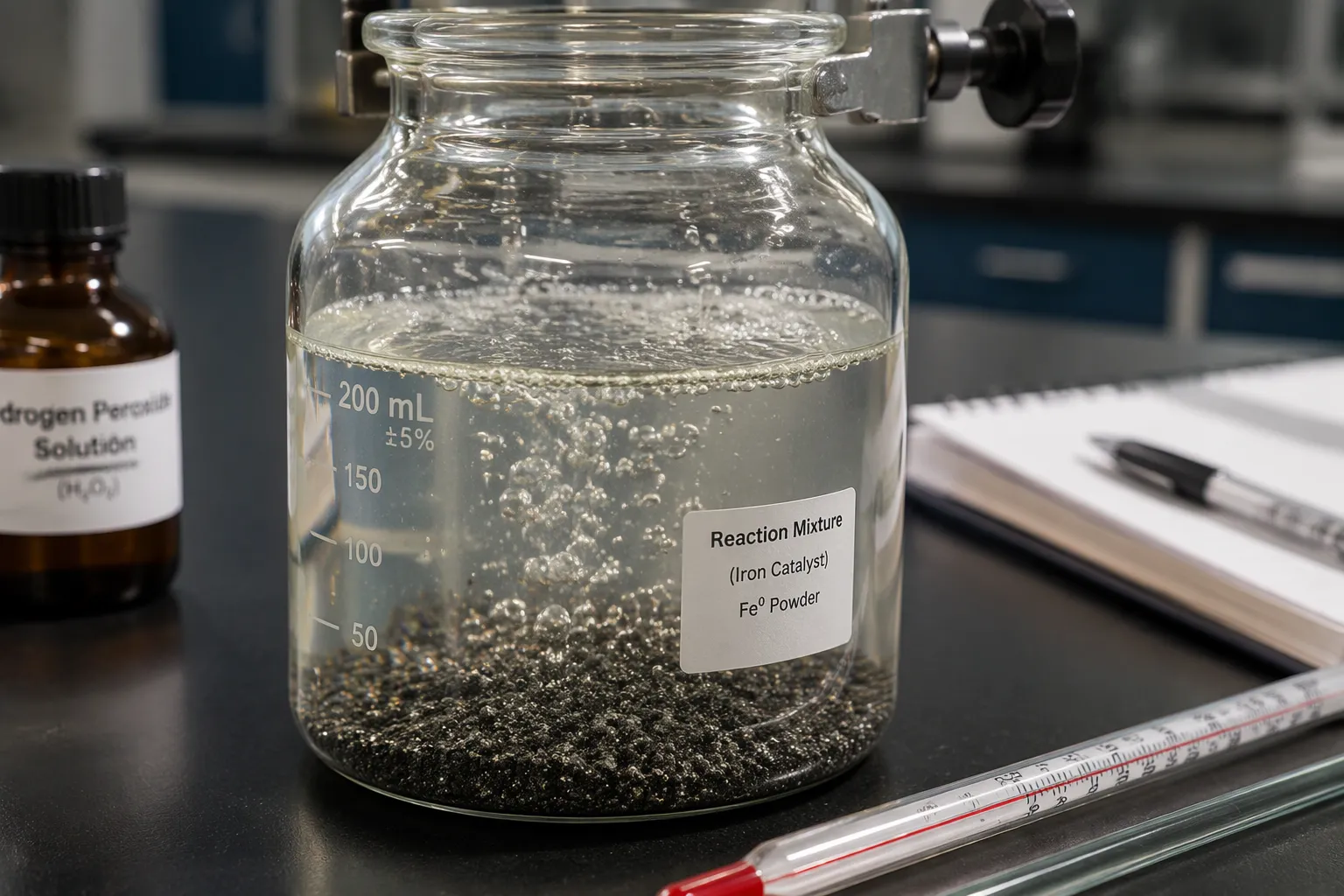
The gap between the conversion a flowsheet promises and the conversion a plant actually reaches is usually closed by a catalyst, not by extra heat. An iron catalyst is a material whose active phase is metallic iron or an iron oxide, and it moves reactants through a lower-energy route without being consumed along the way. It joins the chemistry, returns to its original state, and runs the same loop again. Because an iron catalyst works by lowering the activation energy of the reaction rather than by shifting the equilibrium, the gain appears as rate: more product per cubic meter of catalyst per hour, at a temperature the reactor can hold.
An iron catalyst matters in industrial service for a practical reason before a scientific one. It sits fourth in crustal abundance, it is cheap relative to platinum and palladium, and it forms oxides that can be shaped into strong pellets. That combination put iron at the center of ammonia synthesis, Fischer-Tropsch synthesis, and the water-gas shift reaction. The sections below cover what the metal does at the surface, which operating variables decide whether it performs, and where an iron catalyst beats the alternatives.
Key Takeaways
An iron catalyst lowers the activation energy of a reaction, so reactants convert faster at the temperature and pressure a plant can actually sustain.
The active phase changes with the duty: metallic iron in ammonia synthesis, iron oxides in shift conversion, and iron carbides in Fischer-Tropsch synthesis.
Iron is the fourth most abundant element in the crust, which is why an iron catalyst stays viable where noble-metal charges do not.
Sulfur, chlorine, arsenic, and phosphorus foul an iron catalyst; the working window is set by temperature, steam ratio, and space velocity.
Promoters such as potassium and structural supports raise activity and hold strength, and a controlled reduction brings a fresh or regenerated charge back to full performance.
What Is an Iron Catalyst?
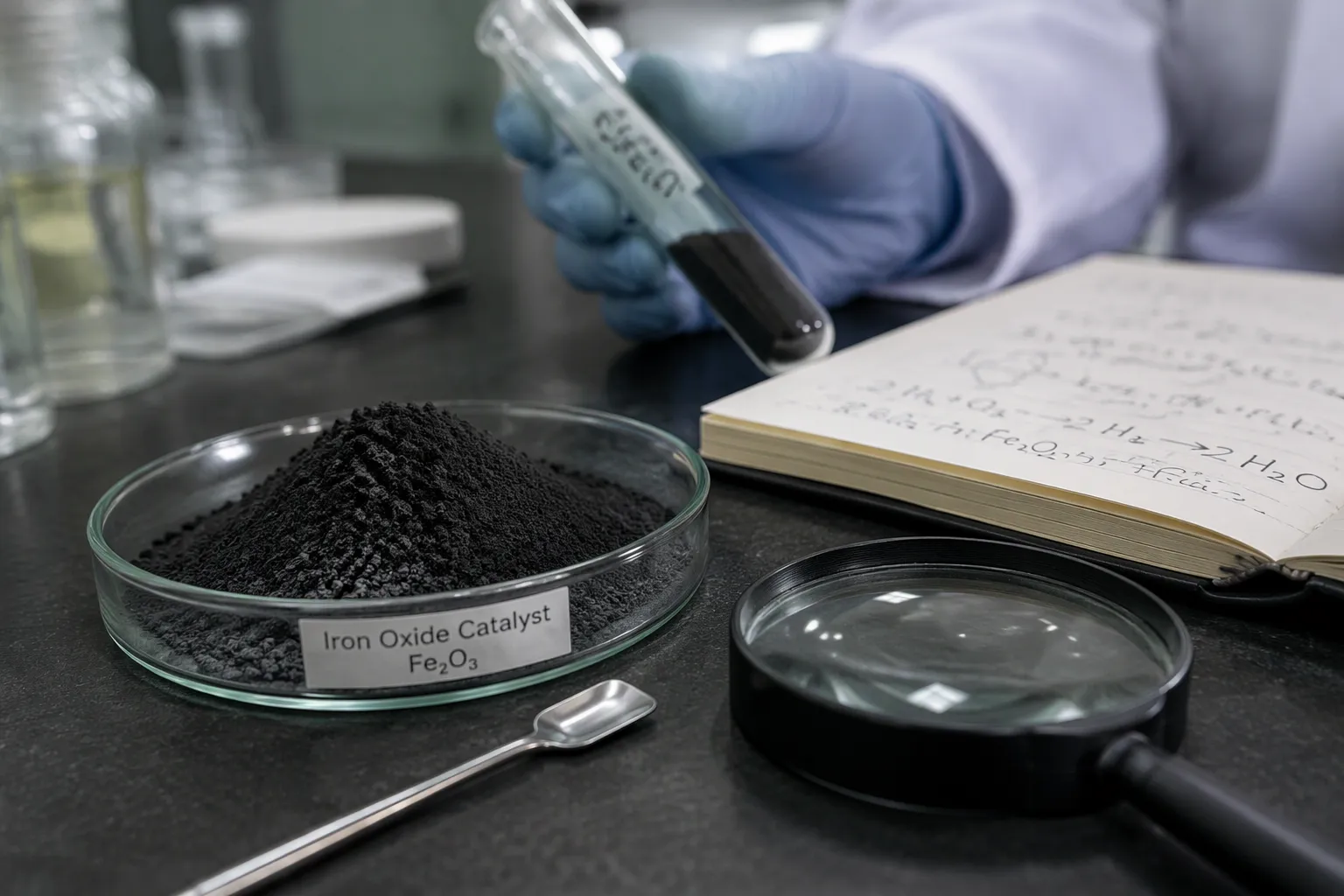
An iron catalyst is a solid whose active component is iron, usually present as an oxide before startup and as metal, oxide, or carbide during service. It accelerates a reaction without being consumed: the iron catalyst offers an alternative pathway with lower energy requirements, and when the reaction is over it returns to the state it started from, ready for the next cycle. That reversibility is what separates a catalyst from a reagent.
Iron as the Active Metal
Iron is the working heart of these materials, and an iron catalyst usually arrives as an oxide rather than as the bare metal. Commercial shift catalysts start from iron raw material and chromic anhydride, are brought together by co-precipitation, and end up with a predominantly γ-Fe₂O₃ phase. Producers then add non-ferrous metal elements and rare earth elements, which improve low-temperature activity, mechanical strength, and resistance to sulfur. These additions matter because the oxide has to survive years of steam, cycling, and pressure.
The versatility of iron comes from its multiple oxidation states. In industrial service the metal moves mainly between Fe²⁺ and Fe³⁺, as in the Fe₂O₃/Fe₃O₄ pair that carries shift conversion, or between Fe⁰ and carbide phases in ammonia and Fischer-Tropsch duty. Each transition accepts or releases electrons, and that electron shuttle is the reason iron can serve as a catalyst in reactions as different as nitrogen fixation and carbon monoxide conversion. Exotic states such as the ferrate(VI) ion belong to specialized oxidation chemistry in water treatment, not to the working cycle of a catalyst bed.
Pure iron rarely delivers its optimum behavior, so formulators add promoters and supports. Potassium and manganese improve selectivity and stability; carbon nanotubes and silica provide a structural framework and raise accessible surface area. The effect can be large. An inverse structure that loads aluminum hydride and potassium onto larger iron particles has been reported to give roughly three times the ammonia yield per catalyst volume of promoted iron alone, at laboratory temperature and near-atmospheric pressure. That result belongs to a low-temperature research system rather than to a commercial ammonia charge, and it illustrates the direction of travel: more active sites per unit area, and easier cleavage of the nitrogen molecule that limits the overall rate.
Key Properties
High surface area and porosity are the two properties that decide how much work a cubic meter of catalyst can do. Pores adsorb reactant molecules and pre-concentrate them above the bulk gas composition, which raises the local reaction rate, and they keep multi-step sequences in proximity so that intermediates meet the next active site instead of escaping. A heterogeneous catalyst such as iron oxide depends on this geometry: greater accessible area means more opportunities for reactants to reach the active metal.
Industrial duty also demands that an iron catalyst hold its shape. Iron-based catalysts resist breakage and pulverization, and that mechanical strength matters most under medium and high pressure, where a crumbling bed turns into a pressure-drop problem before it becomes a chemistry problem. Reusability depends on keeping active sites available. Surface passivation, where oxide layers build up or contaminants accumulate, reduces the number of working sites; correct operating conditions and scheduled maintenance limit the loss. Reduction is the step that activates a fresh charge and restores activity after regeneration.
Iron vs. Other Catalysts
Iron ranks fourth among the elements of Earth's crust, behind oxygen, silicon, and aluminum, and survey data put its share of the upper continental crust near 3.9 wt%. That abundance is a supply argument before it is a cost argument: ore is widely distributed, extraction is straightforward, and pricing is less exposed to the shocks that hit minor metals. Against platinum and palladium the cost gap is large, and those metals are recovered from large volumes of low-grade ore, which keeps their price structurally high. Iron is also comparatively low in toxicity, which simplifies handling and waste disposal at the end of a campaign.
The trade-off is that iron is rarely the most selective option. Cobalt-based catalysts deliver higher selectivity in some Fischer-Tropsch applications, nickel catalysts serve hydrogenation well, and platinum group metals remain the standard in automotive emission control. An iron catalyst fits where cost, supply, and adequate performance line up: ammonia synthesis through the Haber process, Fischer-Tropsch synthesis of liquid hydrocarbons from syngas, water-gas shift conversion, and a growing set of environmental and wastewater duties.
How Does an Iron Catalyst Speed Up Reactions?
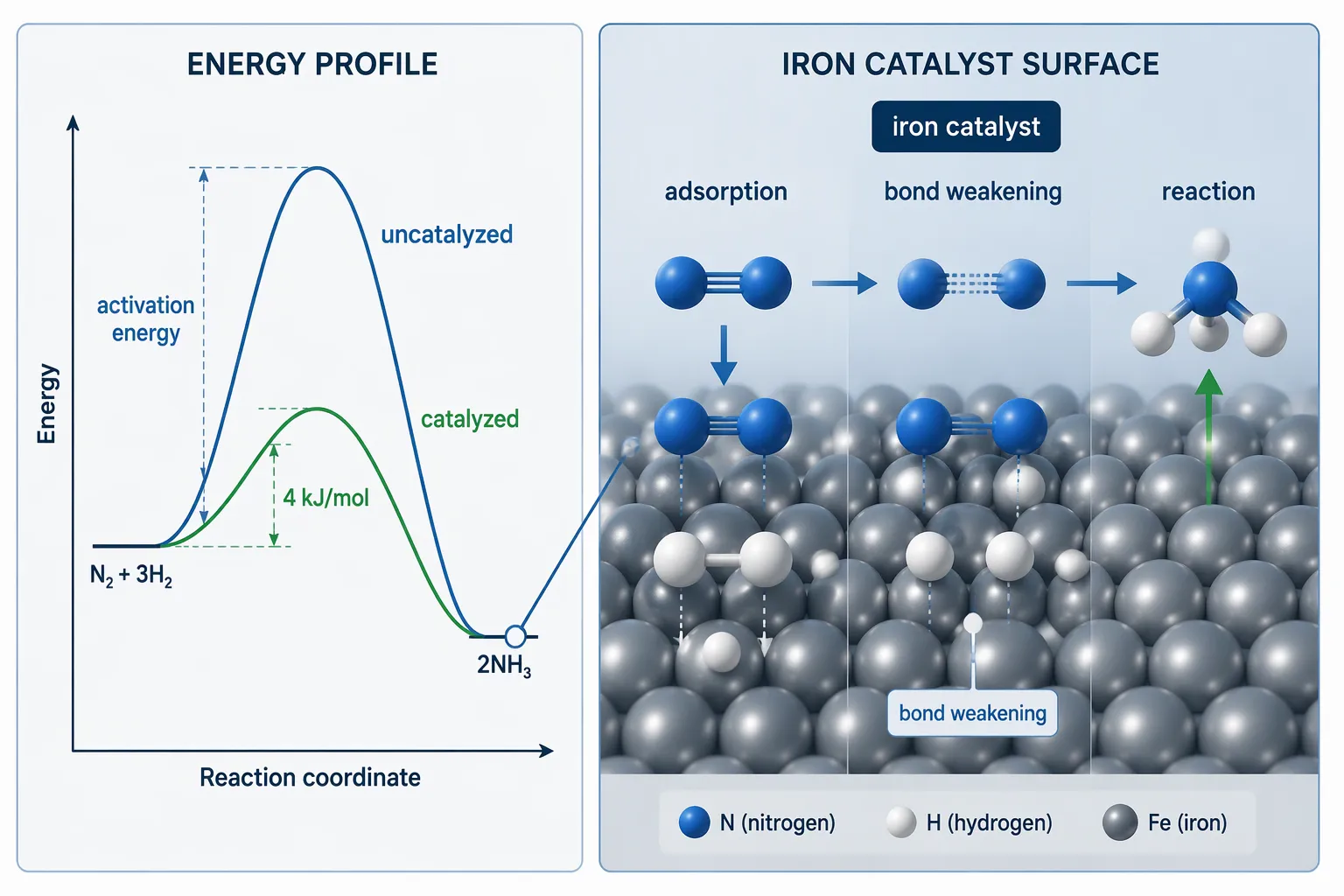
An iron catalyst lowers the activation energy a reaction must clear, so reactants convert faster at unchanged temperature. This is what an iron catalyst does in a plant: it offers a route that demands less energy, and the same reactor, at the same conditions, produces more.
Lowering the Activation Energy
Every reaction faces an energy barrier. Reactant molecules must gain enough energy to break old bonds before new ones can form, and at any given temperature only a fraction of the molecules carries that much energy. Heating the system pushes more of them over the hill, but heat costs fuel, raises the equilibrium limitation in exothermic reactions, and can damage both catalyst and equipment. An iron catalyst changes the landscape instead of the temperature: it opens a path that crosses a lower hill, so a far larger share of molecules completes the journey at the conditions the plant already runs.
Providing a Reaction Surface
In reactions such as the Haber process, the iron surface is where nitrogen and hydrogen meet. The cycle starts with adsorption: gas molecules stick to the metal through weak forces and chemical bonding, and the fraction of arriving molecules that actually stick is the sticking coefficient. Catalytically active metals make d orbitals available for that bonding, which explains both their activity and their vulnerability to poisons that bind the same sites.
Adsorption alone is not enough. The surface must also weaken the bonds that are about to break. The N≡N triple bond is the classic case: electron donation from iron's d orbitals into the antibonding orbitals of adsorbed nitrogen softens the bond until it splits into individual atoms, and hydrogen splits in the same way. The surface-mediated route cuts the energy required for bond breaking, so ammonia forms at far milder conditions than the uncatalyzed reaction would allow. Promoters such as potassium oxide modify the electronic properties of those sites and lower the barrier for nitrogen dissociation further.
The Catalytic Cycle
The cycle runs as a repeating loop in three stages. Reactant molecules adsorb onto the surface; bonds break and new bonds form between the adsorbed atoms; the product desorbs and frees the site for the next round. In ammonia synthesis, nitrogen and hydrogen adsorb, their bonds split, the atoms combine into ammonia, and the ammonia leaves. The surface emerges from each loop unchanged, which is why a small charge of iron catalyst serves a very large flow of gas.
A parking garage makes the loop easy to picture. Spaces are limited, cars enter, park briefly, and leave, and each departure frees a space for the next arrival while the garage itself never changes. Reactant molecules park on the catalyst surface, react, and drive away. The redox mechanism fits the same picture: iron oxides shift between oxidation states as they shuttle electrons, and each shift returns the surface to a state ready for the next cycle. Reduction during startup activates a fresh charge, and reduction after regeneration restores one, so a well-run cycle keeps the surface productive for years.
What Affects Iron Catalyst Performance?
Temperature, pressure, impurities, and physical form decide how well an iron catalyst performs. The XYFB113 medium-high temperature CO shift catalyst shows how these variables interact in a real specification.
Temperature and Pressure
The XYFB113 begins to show noticeable activity at 250 °C and reaches its optimum conversion at an inlet temperature of 250–280 °C. The table below summarizes the operating parameters published for this grade.
Parameter | Value |
|---|---|
Inlet temperature for optimum conversion | 250–280 °C |
Gas temperature into converter furnace | 280–290 °C |
Operation temperature | 310–350 °C |
Catalyst bed temperature | 340–460 °C |
Normal working range | 360–460 °C |
Maximum temperature | 480 °C |
Transient peak limit | 500 °C |
Operating pressure | Atmospheric to 8.0 MPa |
Space velocity, dry gas (0.7–5.0 MPa) | 600–3000 h⁻¹ |
Space velocity at 8.0 MPa | Below 4000 h⁻¹ |
Minimum steam-to-gas ratio | 0.5 |
Those numbers bound the operating envelope rather than describe a single point. The steam-to-gas ratio of at least 0.5 is the practical floor: higher ratios drive the equilibrium toward hydrogen but cost steam, so plants run close to the floor once the charge is fully active. A low apparent activation energy across the iron-chromium family is part of why this works, because an iron catalyst bed keeps converting at moderate steam addition instead of demanding a large excess.
Excessive heat shortens catalyst life. Beyond 480 °C, and certainly past a transient 500 °C, the surface sinters and activity falls away. A slow, even reduction during startup protects against local overheating, and it also preserves the redox behavior that drives the shift reaction.
Poisons and Impurities
Sulfur is the poison that matters most in shift service. Hydrogen sulfide and carbonyl sulfide react with the iron surface and occupy active sites, and chlorine, arsenic, and phosphorus attack it in the same way. Iron-chromium formulations tolerate small quantities of sulfur far better than copper-based low-temperature catalysts, whose sites are irreversibly damaged by traces, but the tolerance is limited: industrial practice keeps total sulfur in the feed down to the tens of parts per million or lower, and modern plants often polish well below that. The claim that an iron-chromium bed absorbs several thousand ppm of sulfur belongs to cobalt-molybdenum sulfur-tolerant catalysts, not to this family. For the comparison that decides which family a plant should install, see low-temperature versus medium-high temperature conversion catalysts.
The grade itself is specified at a bulk sulfur content of no more than 250 ppm, which is low enough that a fresh charge needs no separate sulfur-release step at startup and production time is not lost to it. That figure describes the catalyst, not its tolerance for sulfur in the gas. Feed gas treatment and steady monitoring remain the real protection.
Surface Area and Form
Catalysis is a surface phenomenon, and finely divided iron powder reacts far faster with acids than a solid nail does. Smaller particles expose more iron atoms, and a higher share of under-coordinated surface sites raises reactivity further. The XYFB113 carries a specific surface area above 90 m²/g in the oxidized state.
Surface area alone does not decide the shape. An iron catalyst ships as dark brown cylinders of Φ9×5–7 mm, meaning 9 mm diameter by 5–7 mm height, with a bulk density of 1.40–1.50 g/mL. That geometry balances pressure drop against surface exposure: too fine, and the bed chokes; too coarse, and the interior of each pellet never sees the gas. Radial crushing strength of at least 210 N/cm resists breakage under pressure, and no more than 10% of a batch falls below 160 N/cm, which is the low-strength fraction that tends to fail first during loading and thermal cycling. The grade is inspected against HG/T3546-2011, the Chinese standard for carbon monoxide high-temperature shift catalysts, and it also holds a specified wear rate, a heat-resistant activity figure, and a loss-on-ignition limit.
Need a shift or ammonia catalyst matched to your gas composition? Send the operating window and we will match the grade.
Get a QuoteWhere Iron-Based Catalysts Are Used
Iron-based catalysts carry several large-scale processes, and each one uses a different strength of the metal.
Haber-Bosch Process
The Haber-Bosch process combines nitrogen and hydrogen into ammonia over a promoted iron catalyst, and that charge remains the standard for the reaction. The surface splits the nitrogen triple bond, the rate-limiting step, and ammonia forms at moderate temperature and high pressure. Potassium oxide promoters raise the number of active sites and speed that step. Ammonia from this route then feeds most of the world's nitrogen fertilizer supply, which is why mechanical strength earns as much attention as activity: an iron catalyst for ammonia synthesis has to hold its shape for years of continuous campaign.
Fischer-Tropsch Process
High-temperature Fischer-Tropsch synthesis runs on iron-based catalysts and has been applied extensively in coal-to-liquid plants. Low-temperature Fischer-Tropsch, the route behind most gas-to-liquid capacity, runs on cobalt or iron depending on the syngas. The distinction matters because the two routes sit in different windows: commercial units operate at roughly 200–350 °C and 20–40 bar, with the high-temperature mode at the top of that range and the low-temperature mode at the bottom. Four metals are active in this chemistry: iron, cobalt, nickel, and ruthenium. An iron catalyst tolerates lower hydrogen content and carries water-gas shift activity of its own, which suits coal-derived syngas. Alkali promotion, typically around 0.5 wt% K₂O, helps iron reach high activity and stability; copper aids reduction, SiO₂ and Al₂O₃ act as structural promoters, and manganese can shift selectivity toward olefins.
Iron's behavior in this duty tracks the phase mix on the surface. Oxides and carbides coexist, and the balance between them shapes both activity and the redox steps during operation, which is why activation and pretreatment are specified as carefully as the catalyst composition itself.
CO Shift and Other Uses
The XYFB113 CO shift catalyst from Henan Xinye Catalyst Co., Ltd. shows the iron-chromium route in practice. The product carries a predominantly γ-Fe₂O₃ composition and serves ammonia, methanol, and hydrogen plants running on natural gas or coke oven gas. Its structural and strength figures are listed above; the operating point is what matters here, because the same charge holds activity across repeated reduction and regeneration cycles when the reduction schedule is respected.
Iron oxides also serve water treatment, where catalytic oxidation over iron surfaces breaks down contaminants. These duties are smaller than a shift converter but rely on the same redox chemistry, and they are one reason an iron catalyst keeps appearing in environmental applications.
 XYFB113 CO Shift Catalyst
Why Choose an Iron Catalyst?
The choice comes down to fit. An iron catalyst works where cost, supply, and mechanical demands line up with the process, and the cases where it does not are equally well defined.
Cost and Availability
Crustal abundance keeps the raw material cheap and the supply predictable. For a plant running continuous operations, that difference shapes the whole catalyst budget, and it compounds across a multi-year campaign. Iron catalysts can also be recycled and reused across cycles, which cuts waste and lowers the cost per ton of product further. Global availability of iron ore smooths pricing, and a straightforward extraction route adds a second layer of reliability for anyone planning years ahead.
Performance Strengths
Mechanical strength matters in medium- and high-pressure equipment, and it is specified rather than assumed: the XYFB113 meets HG/T3546-2011 and holds radial crushing strength of at least 210 N/cm before reduction, with the low-strength fraction capped at 10% of a batch. Promoters tune the rest. Potassium oxide raises site count in ammonia synthesis, copper aids reduction at startup, SiO₂ and Al₂O₃ hold the structure, and manganese shifts selectivity toward olefins in Fischer-Tropsch work. That flexibility lets engineers match a single iron family to very different duties.
Matching Catalyst to Job
No single catalyst serves every purpose, so the useful question is which family fits a given feedstock, product, and pressure envelope. The table below sets the main options side by side.
Catalyst family | Cost and supply | Sulfur tolerance | Typical duty |
|---|---|---|---|
Iron and iron oxide | Low, widely available | Moderate; still needs desulfurization | Ammonia synthesis, shift conversion, Fischer-Tropsch |
Cobalt | High and volatile | Low; clean syngas required | Low-temperature Fischer-Tropsch on natural gas |
Copper-zinc | Moderate | Very low; traces cause irreversible damage | Low-temperature shift, methanol synthesis |
Platinum group metals | Highest | Low | Automotive emission control, fine chemicals |
Read the table as a starting point, not a verdict. For most large-scale units an iron catalyst remains the default for shift and ammonia duty, and the exceptions are the cases where selectivity or a very low sulfur level dominates. An iron-based catalyst fits where cost, abundance, and adequate performance align with process needs; the decision still depends on specific requirements and operating conditions.
Comparing grades for an ammonia, methanol, or hydrogen plant? Ask for the technical data sheet and a specification review.
Contact UsAn iron catalyst is a solid whose active phase is iron metal, iron oxide, or iron carbide, and it accelerates a reaction without being consumed. It lowers the activation energy, provides a surface where reactants adsorb and bonds weaken, and returns to its starting state after each cycle. Temperature, steam ratio, space velocity, and poisons such as sulfur, chlorine, arsenic, and phosphorus set the working envelope. The same chemistry carries Haber-Bosch ammonia synthesis, Fischer-Tropsch fuels, and CO shift in hydrogen plants, and in each case a controlled reduction decides how much of the designed activity a fresh or regenerated charge actually delivers. An iron catalyst remains an affordable, abundant base for that work. If you are sourcing a charge for a shift, ammonia, or methanol unit, talk to a manufacturer who can match the grade to your gas and your pressure envelope rather than to a catalog page.
FAQ
What is an iron catalyst?
An iron catalyst is a material whose primary active component is iron, present as metal, oxide, or carbide depending on the duty. It accelerates a reaction without being consumed: it participates, returns to its original state, and repeats the cycle many times.
How does an iron catalyst speed up reactions?
An iron catalyst lowers the activation energy by offering an alternative pathway across a lower barrier. At the same temperature, a larger share of reactant molecules converts, and the surface gives reactants a place to adsorb and react.
What temperature does the XYFB113 catalyst operate at?
Activity becomes noticeable at 250 °C, with optimum conversion at an inlet temperature of 250–280 °C. The normal working range is 360–460 °C, the maximum is 480 °C, and 500 °C is a transient limit only.
What factors affect iron catalyst performance?
Temperature, pressure, impurities, and physical form. Sulfur, chlorine, arsenic, and phosphorus block active sites, while surface area, pellet size, and steam ratio set how much conversion the bed can deliver.
Where are iron-based catalysts used?
Ammonia synthesis through Haber-Bosch, Fischer-Tropsch synthesis of liquid fuels from syngas, CO shift service in ammonia, methanol, and hydrogen plants, and water treatment. High-temperature Fischer-Tropsch and coal-derived syngas favor iron; natural-gas gas-to-liquid favors cobalt.
How does reduction affect catalyst performance?
Reduction converts the oxide to the working phase and opens the active surface. A slow, even schedule avoids local overheating, protects strength, and restores full activity after regeneration.
Sources: USGS, Iron (Fe) element profile from the 2017 soil geochemistry survey; LibreTexts Geosciences, Abundance of Elements in Earth's Crust; OpenStax, Chemistry 2e, section 12.2; LibreTexts, Physical Chemistry, section 29.8; XYFB113 technical data sheet, Henan Xinye Catalyst Co., Ltd.


